

Our perspectives
in one place
Topic
Selected filters
Clear
News
See allEnsuring harmonized approaches to life cycle assessment of health products
The global innovative pharmaceutical industry recognizes the increasing interest from health systems, procurers, and policymakers in understanding the environmental footprint of medicines and vaccines. As conversations evolve around product-level life cycle assessment (LCA), it is vital that any emerging frameworks support clarity, methodological consistency, and insights that enable companies to improve their own environmental performance....
Read moreStatement at the fifth meeting of the open-ended Intergovernmental Working Group (IGWG 5) on the WHO Pandemic Agreement
On 9 February 2026 in Geneva, IFPMA delivered a statement at the fifth meeting of the open-ended Intergovernmental Working Group (IGWG 5) on the WHO Pandemic Agreement.
Read more158th session of the WHO Executive Board (EB158): Reform of the global health architecture and the UN80 initiative
On 6 February 2026, IFPMA delivered a statement on Agenda item 29.1 on reform of the global health architecture at the 158th session of the WHO Executive Board in Geneva. The innovative pharmaceutical industry views this process as a critical opportunity to build a stronger, truly fit-for-purpose global health architecture. As a trusted and official...
Read more158th session of the WHO Executive Board: WHO’s work in health emergencies
We appreciate the opportunity to contribute to the discussions at EB158. WHO’s work on strengthening emergency preparedness reflects a shared commitment to ensuring the world is better equipped for future health threats. We welcome this direction and the emphasis on clarity, coordination, and readiness. As EB158 documents highlight, WHO will now take on an expanded set of responsibilities...
Read more158th session of the WHO Executive Board (EB158): Draft updated global action plan on antimicrobial resistance
On 4 February 2026, IFPMA delivered a statement on Agenda item 14 on the draft updated global action plan on antimicrobial resistance (AMR) at the 158th session of the WHO Executive Board. We welcome the timely update of the Global Action Plan on AMR (GAP), which provides a unique opportunity to take stock of progress...
Read more158th session of the WHO Executive Board (EB158): Harmonization of regulatory approaches, governance, and standards for data, digital health, and artificial intelligence in the health sector
On 4 February 2026, IFPMA delivered a statement on Agenda item 15 on harmonization of regulatory approaches, governance, and standards for data, digital health, and artificial intelligence in the health sector at the 158th session of the WHO Executive Board in Geneva. Noting the work carried out by several multilateral institutions on digital health transformation,...
Read morePublications
See allArtificial intelligence in pharmaceutical manufacturing – navigating innovation and regulation
Artificial Intelligence (AI) and Machine Learning (ML) are rapidly transforming various sectors, and the pharmaceutical manufacturing industry is no exception. This paper explores how the pharmaceutical industry may use individual applications of AI in pharmaceutical manufacturing and control. It describes the evolving regulatory landscape and provides key considerations for national regulatory authorities (NRA) when reviewing...
Read more
Financing health systems: Leveraging the benefits of investing in prevention against NCDs
Investing in the prevention and treatment of non-communicable diseases (NCDs) can strengthen health systems, protect economic productivity, and improve population wellbeing. Evidence shows that every dollar invested in preventing and managing NCDs generates substantial returns through reduced healthcare costs, improved workforce participation, and healthier, more resilient societies. Yet despite this compelling investment case, progress remains...
Read moreWhy orphan medicines remain out of reach in low- and middle-income countries – and what can be done
Rare diseases, comprised of more than 7,000 conditions, are a major global health challenge, affecting over 300 million people worldwide. In low- and middle-income countries (LMICs), the burden is substantial and likely underestimated due to underdiagnosis, weak surveillance, and limited access to early diagnosis and preventive care. Even where treatments exist, access to orphan medicines...
Read more
Expert insights
See all
A better global health architecture delivers both innovation and access
Read more
A new dawn in global health: UHC as the path toward national health stewardship
Read more
Health as an economic priority – building on momentum driven by the G20 South Africa Presidency
Read moreResources
See allStreamlining samples management to strengthen health outcomes in Africa
Ensuring the quality, safety, and efficacy of pharmaceutical products is a cornerstone of public health. To meet these high standards, innovative multinational pharmaceutical companies perform rigorous batch release testing for every product, following internationally recognized protocols and approved specifications. However, countries may require additional in-country testing by their National Regulatory Authorities (NRAs) or National Control...
Read more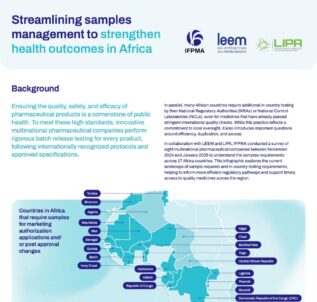
Our Ethos in Action – Decision-Making Framework Toolkit
IFPMA has developed a Five-Phase Decision-Making Framework, grounded in the IFPMA Ethos or value system, to help companies make decisions that balance business objectives and ethical considerations to meet patient needs and the expectations of the medical community, regulators, and society.
Read more
February 2024: Impact of a waiver of intellectual property rights for COVID-19 therapeutics
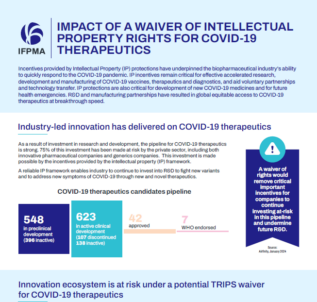
As discussions on an extension of a waiver of intellectual property (IP) rights on COVID-19 therapeutics continue, latest evidence and data published today explains what the adverse impact of a waiver may be on the entire innovation ecosystem and the consequences it may have on industry’s ability to fight future pandemics.
Read more